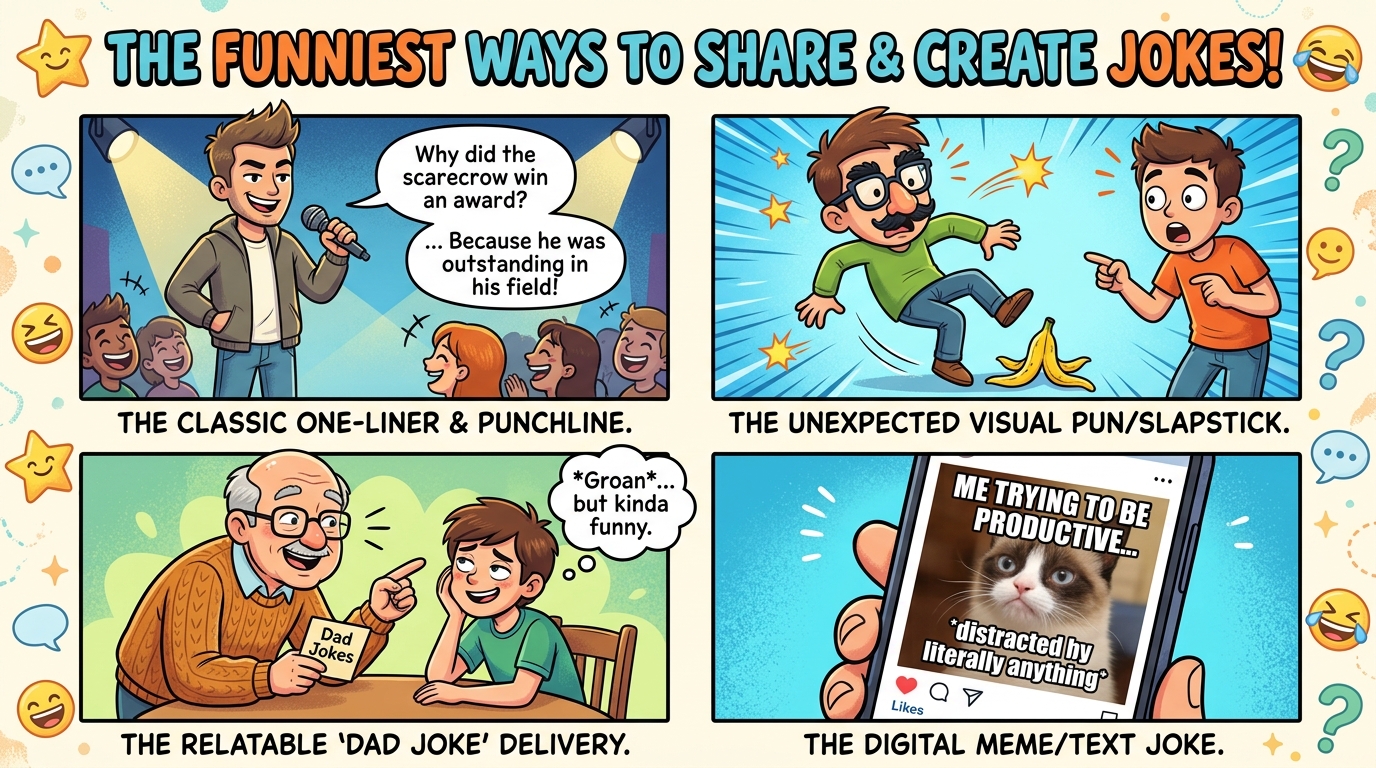
Every funny person you know believes they could write jokes, and every working comedian knows why they mostly cannot: a joke is not a funny thought, it is a small machine with two parts — a setup that builds a precise expectation and a punchline that breaks it in a way that still makes sense. How to write a joke is a learnable craft with rules that can be practised like scales, and this guide lays them out: the anatomy, the writing process comedians actually use, the rewrite discipline that does most of the work, and the testing loop that separates a joke that reads funny from one that lands in a room.
The Anatomy: Setup, Assumption, Punchline
Strip any working joke and you find the same skeleton. The setup gives the audience information and quietly installs an assumption — the audience believes the story is going one way. The punchline reveals a second, hidden interpretation that was compatible with the setup all along. The laugh is the sound of the audience’s brain resolving the surprise and the logic at the same time; if it is only surprising, you get confusion, and if it is only logical, you get a nod. This is why the classic forms catalogued in our guide to the types of jokes — puns, one-liners, knock-knocks — all work: each is just this skeleton in different clothing. When a joke of yours fails, diagnose it against the skeleton first: usually the assumption was never installed (the audience did not know what to expect) or the punchline breaks the setup instead of reinterpreting it.
Start From the Punchline (or the Premise)
Beginners write setups and hunt for endings; professionals usually start at one of two ends. Punchline-first: you notice a genuinely funny collision — a word with two meanings, an absurd comparison, an uncomfortable truth stated plainly — and then you engineer the shortest setup that installs exactly the assumption the punchline needs. Premise-first: you take a topic with emotional charge (airports, dentists, group chats, your father’s driving) and list its honest irritations and exaggerations until one of them bends into a punchline. Both routes run on the same fuel: specificity. “Airports are annoying” is a topic; “the security tray is the only place my laptop, shoes and dignity travel together” is a joke embryo. Write ten embryos for every one you develop — joke writing is a numbers game disguised as inspiration, and the ratio of discarded to kept material among professionals is brutal and normal.
The Rewrite: Where Jokes Are Actually Made
First drafts are ore. The rewrite applies the craft’s three great compressions. Cut the setup to the minimum the assumption requires — every word before the punchline is a word the audience spends not laughing, and most amateur jokes are 40% too long. Put the funniest word last: the punchline’s trigger word must be the final word of the sentence, because anything after it steps on the laugh. And sharpen the target: jokes are about something specific being true, so replace generalities (“my boss is cheap”) with evidence (“my boss reuses the office birthday card — my name is third under two crossings-out”). A useful drill: take any joke you have written and produce three versions — shorter, more specific, and with the trigger word moved to the end — and feel how the same idea gets measurably funnier without changing its content at all.
Tags, Callbacks and Building a Bit
One laugh is a joke; a bit is a small economy of them. A tag is a second punchline appended immediately after the first, exploiting the same assumption while the audience is still laughing — the highest-value real estate in comedy, because the setup cost is already paid. Callbacks return to an earlier joke’s world later in the set, and land disproportionately hard because the audience feels clever for remembering. When you write, therefore, do not file jokes as isolated lines: for every premise, ask “what else is true in this world?” The security-tray joke has siblings (the pat-down, the liquids bag, the gate-change sprint), and a premise with five true, specific observations is a bit; a premise with one is an opener. Professionals think in these clusters, which is why their notebooks look like family trees rather than lists.
Testing: The Room Is the Editor
No joke is finished on the page, because timing, emphasis and audience assumption are performance variables paper cannot measure. Test new material in low-stakes rooms — open mics, friends who will be honest, a recording of yourself read aloud at minimum — and judge by evidence: where exactly did the laugh start, how long was it, and did the tag out-laugh the punchline (a sign the real joke is the tag, and the original punchline should become its setup)? Change one variable at a time between tests, or you will never know what fixed it. Keep a simple ledger: joke, room, result. Within a few months the ledger teaches you your own patterns — the topics you write best, the lengths your voice carries, the assumptions your audiences reliably make — and that self-knowledge is worth more than any single technique in this guide.
Four Beginner Mistakes (and Their Fixes)
Explaining the joke — if the audience needs the footnote, the setup failed; fix the setup, never add the explanation. Apologising in advance (“this is probably not funny, but…”) — it instructs the room not to laugh and it obeys. Stealing the skeleton of a famous joke and changing the nouns — audiences smell the original, and the craft you skip is the craft you needed. And performing only for other comedians: rooms of comics laugh at structure, civilians laugh at recognition, and a joke that only impresses the back of the room is a magic trick shown to magicians. Test on the audience you actually want.
The Bottom Line
How to write a joke is a discipline disguised as a gift: build the two-part machine, start from collisions or charged premises, write ten to keep one, compress until the funniest word lands last, grow jokes into bits with tags and callbacks, and let real rooms grade the results. Do that weekly and the “gift” appears — on schedule, like any other craft.